When seeking a model for the craftmanship, drive, and attention to detail that I strive for in my work I look no further than Matt Coe of Coe Percussion. Matt Coe has been building breath-taking mallet instruments for 20 years with no sign of letting up. Matt’s responses to the following questions excellently reflect his expertise and solidify him as a pillar of the instrument manufacturing community.
Interviewer: “What makes you and your work unique?”
Matt: “I’m completely self-taught. I went to music school, but have a very mechanical background growing up so that lends itself very well for making musical instruments. I don’t think there is any other manufacturer with the mix of musical and mechanical ability that I have.”
Interviewer: “Do you have a brand or artist statement?”
Matt: “COE Percussion, LLC and the ‘COE’ logo.”
Interviewer: “Do you have a mission or vision?”
Matt: “In my mind I do but not on paper. I don’t believe you need to write down a mission statement on paper-waste time.”
Interviewer: Do you have career goals laid out for the next 5-10 years?
Matt: “Yes, I’d like to buy a building and preferably an old Church or similar where there is a small auditorium and also space for the manufacturing of instruments. The auditorium would be used for testing completed instruments and holding masterclasses and concerts for people brought in to do those sorts of things.”
Interviewer: “How are you connecting and building audiences and how are you marketing to them?”
Matt: “Mainly word of mouth through a reputation built over the last 20 years. I also occasionally go to trade shows. Web marketing and social media are really the new trade shows in the modern world and that is something I need to do more of.”
Interviewer: “What opportunities are you on the lookout for?”
Matt: “Always looking for a rosewood substitute. I also need a social media networking person to help me in that area.”
Interviewer: “Did you look at someone else’s career to make a path for your own and if so, what was it?”
Matt: “Not particularly although my dad worked for himself and I always admired that. I pretty much had to build my own career as there aren’t many models for careers building marimbas and xylophones.”
Interviewer: “How did you initially get funding?”
Matt: “I worked at a music store and saved as much as I could from that job during the day and at night I rented a small shop and worked there until about 1:00 AM for several years. Over time I started working less at the music store and more at the shop. Luckily I was in a position where I could do that. I scraped by for quite some time until I was full time at my shop.
Interviewer: “What networks or organizations do you belong to and which ones have helped you the most?”
Matt: “Percussive Arts Society, National Association of Professional Band Instrument Repair Technicians. (Not current in either of them though) PAS probably helped most through going to PASIC and advertising in Percussive Notes/Publications but that was a long time ago and times have changed. Now it is all internet based where the help comes from and social media. When I first started this I reached out to as many manufacturers as possible looking for a job and no one wanted to hire me. Once I decided to go on my own I did get some pointers from a few individuals about how to build the instruments. It is always good to talk to as many people close to the field you are in as possible, even if they don’t offer help. I used that type of reaction to fuel my desire to suceed on my own.”
I’m doing my case study on Mike Johnston, a professional drummer and educator. Mike began his career doing studio session work and playing in local California rock bands, but soon realized his passion was for education. He has since hosted music camps, played at many education clinics, and published multiple technique and teaching books, but Mike’s largest project has been his online education program. Now through his online classes, he has hundreds of prerecorded lessons, and gives 3 live video lessons per week. I have emailed him to try and get specific answers to these questions, but have not heard back yet, if he does get in touch with me I will update this post.
What makes you and your work unique?
Mike Johnston was one of the first musicians to offer comprehensive online music education. For what a normal in-person lesson usually costs, he gives you access to a back catalog of hundreds of specific lesson topics, and up to 12 live video lessons.
Do you have a brand or artist statement?
His brand would be offering affordable and professional music education to as many people as possible.
Do you have a mission or vision?
Same as above.
Do you have career goals laid out for the next 5-10 years?
In an interview with Modern Drummer, Mike stated that his upcoming goals included traveling to more live clinics, offering more education camps aimed at other educators, and improving his own skills as a musician.
How are you connecting and building audiences and how do you market to them?
Mike has a strong social media presence and often uploads short video lessons to YouTube for free.
Did you look at someone else’s career to make a path for your own and if so, what was it?
He has stated that his main inspiration has been his own frustration with how he received private lessons, and talking to other drummers while he was on tour.
How do you fund your work?
He of course charges for his online lessons, as well as appearances at clinics and for recordings.
How did you initially get funding?
Mike has said that at the beginning, he had to scrape together money from as many sources as possible. playing as many shows and recordings as he could, and offering lessons all over town.
What networks or organizations do you belong to and which ones have helped you the most?
He is currently a member of PASIC and of course his own online company that he started. He is seeing massive success with his website, with over 10,000 members currently.
I
created my artist case study on Bob Reynolds, a saxophonist, composer, and
music educator. Bob writes in his bio that it’s a rare saxophonist who is as
comfortable in a Rock arena as in an intimate jazz club. Bob Reynolds is a rare
saxophonist. I reached out to Bob because he grew up in Jacksonville, Florida
and we are both alumni of the same high school, Douglas Anderson. He’s an avid
proponent of helping other young saxophonists navigate the world of the music
industry and become better musicians especially through his vlog series on
YouTube. Bob has worked with everyone from John Mayer, Usher, Snarky Puppy,
Josh Groban, Willie Nelson and Nellie McKay. I admire the career path that Bob
has chosen to follow because he is extremely versatile as a musician and
refuses to be boxed in to one specific genre. Because of this attitude he has
been able to perform at a high level in a multitude of different musical
avenues. Besides being an incredible sideman he’s also a Grammy winning artist
with 9 top selling solo albums to his credit. I conducted an email interview
with Bob and he was happy to help and glad that I’m part of a class which
addresses these issues for being a musician in 2019. Although he’s a busy
fellow, he wanted to help and was not able to answer all of my questions but
did provide me with numerous links to interviews and videos which answer these
questions.
What makes you and your
work unique? As a saxophonist, Bob’s work is unique because he refuses to
compromise with what he truly wants to say through his horn. Because of all of
the diligent work he’s put in, he’s able to choose who he wants to work with
and what kind of music he wants to play. He’s studied the from master
recordings of jazz but did not stop there. His work in jazz informed his
ability to step into any musical arena. He’s a proponent of keeping the spirit
of jazz alive in the music he plays insofar as making sure that there’s always
a conservation in the music driven by improvisation. He learned early on from
his experiences in college and as a young player that playing in such a way
that will just impress peers and teachers can possibly lead one down a path
that boxes them into playing something that is in a way, ingenuine. Rather, Bob
looks within to ask himself what kind of burning desire he has to play and what
makes him pick up the horn repeatedly every day.
Do you have a brand or artist statement? From his website “Reynolds’ records reflect his affinity for the jazz tradition at
the same time as they display his skill with pop music. He makes the music he
wants without compromise. For Reynolds, music is about communication with the listeners.
One of his album titles, Somewhere in Between,
suggests his ability to cross genres.” “Inventive. Unconventional. An instantly
recognizable player with his own musical vision who still finds a way to fit in
no matter what the situation. As a leader or a band member, Reynolds is focused
on melody, connection, and emotion. Say it again: Bob Reynolds is a rare
saxophonist.”
Do you have a mission or
vision? Bob’s mission is to inspire and help other musicians not only through
his playing but through his vlog series. He is a passionate educator and in
demand as a clinician. He co-founded an annual retreat for saxophonists and gives
private mentoring online to students through his Virtual Studio. His vlog
series shares pertinent insight on living in a large Metropolis such as Los
Angeles being a musician and balancing his musical career with life and raising
a family. He hopes to show that the path he’s laid out for himself is achievable
through hard work and diligence.
Do you have career goals
laid out for the next 5-10 years? Ultimately, Bob wants to work and collaborate
with guitarist Pat Metheny on a project whether it be his own album or one of
Pat’s.
What do you do and what
are you doing? He’s geared towards maximizing his practice and ironing out as
much as he can on the tenor saxophone. He realizes who he is as a musician and
knows that he’s not the guy who gets called to play flute or clarinet because
he wants to continue with his love for tenor. Bob is working as hard today in
the practice room as he was when he first picked up the horn. He continues to
expand his range of musical influences making sure to receive inspiration from
as many genres as possible and views his taste based on a mood filter rather
than a genre based filter. Bob wants to be able to do anything and everything
so that he can choose and play with confidence.
How are you connecting
and building audiences and how do you market to them? First off, Bob is
building his studio of musicians he teaches and his music serves as a platform
to bring in more students anywhere from 15 and 16 year old students to people in
their 50s and 60s learning to love playing the saxophone again. Bob has an incredible insight
on how to make his music appreciated by a wide variety of audiences. Playing
with John Mayer opened the door for him to be vunerable after studying jazz for
so long he dispelled any preconceptions about having to play all the language
of great jazz masters all the time so people would know that he could really
play the saxophone. Rather, Bob is focused on playing with clear and concise melody
with a great time feel which everyone can appreciate.
Did you look at someone else’s career to make a path for your
own and if so, what was it? Bob was actually initially interested in movie
music. The saxophone fell into his lap because he wanted to play an instrument
(any instrument) so he could make his own music for his home films like John Williams.
He was gifted the saxophone by chance because his neighbor had one that their
daughter used to play but never got touched anymore and so they said if Bob wants
it, he could have it. For Bob, playing saxophone it was never about one
particular person. He found a multitude of interests and people he admired and
he was driven by wanting to be in that club. “Kenny
G was my gateway drug. When I was thirteen and fourteen he was all over the
radio and VH1. But soon I discovered Stan Getz and fell in love with his tone.
Over the next few years the list got long: Sonny Stitt, Dexter Gordon,
Cannonball Adderley, John Coltrane, Sonny Rollins, Joe Henderson, Charlie
Parker, Stanley Turrentine, Michael Brecker, Kenny Garrett, Branford Marsalis,
Bob Mintzer, Kirk Whalum, Eric Alexander, Joe Lovano, George Garzone, Mark
Turner, Seamus Blake…”
How do you fund your
work? For Bob, he knew that he would not make the majority of his revenue from
solo albums. For him, his solo work was an investment in the longer-term picture.
He knew that he would have to have other means of acquiring revnue such as
being a sideman and playing with Snarky Puppy or John Mayer. Bob also funds a
lot of his projects through his private lessons service and demand as a clinician.
How did you initially get
funding? Bob always felt ambivalence towards focusing entirely on his
marketing campaign and social media presence. He understands the importance of
it and there’s definitely a dichotomy between making sure that the product
underneath (his music) is valuable and amazing in and of itself or else all the
marketing in the world won’t hold water. His philosophy is to be so undeniably
good at what he does that it can’t be ignored
What networks or
organizations do you belong to and which ones have helped you the most?
One of Bob’s most successful outlets has been through YouTube
and the influence he’s had on other musicians and especially saxophone players.
It has been a platform that has widely helped him expand his audience.
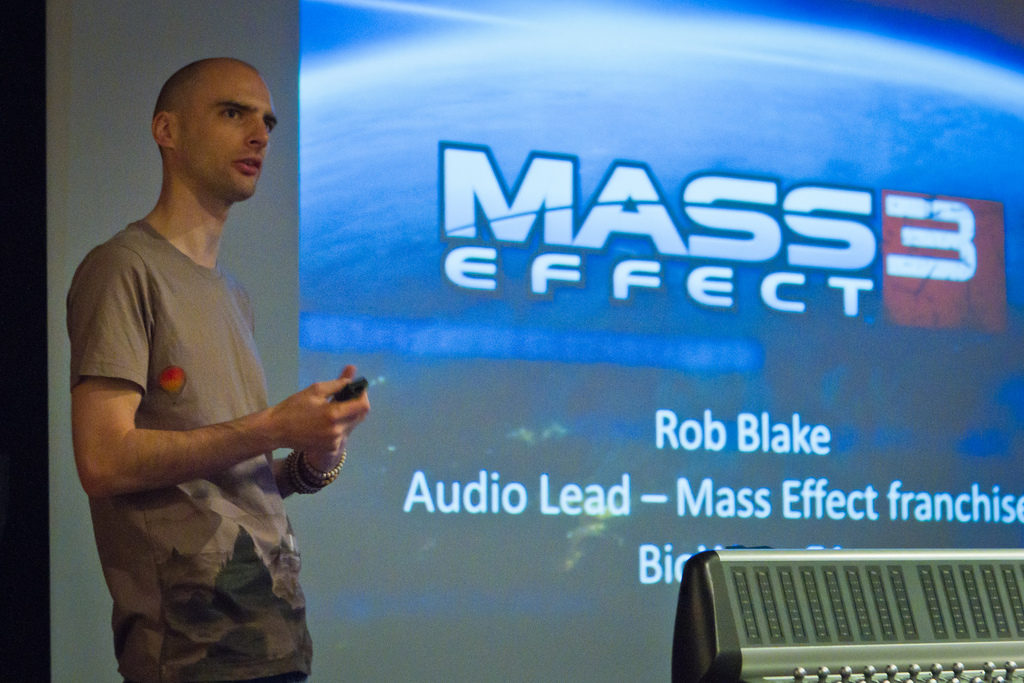
Rob Blake is a Canadian sound designer and game developer best
known for his work on the Mass Effect and Plants Vs. Zombies Series.
Born in the UK, Blake graduated with degrees in Film and
Sound Design from the Arts University Bournemouth in 2000. Blake spent time
after his graduation freelancing as a sound designer for film and television,
before landing a position as a Senior Audio Designer with Blitz Games in 2004.
He has since worked in lead positions in a variety of companies, Tagnarian
Studios in 2007, Bioware in 2008, Electronic Arts in 2012, and finally Phoenix
Labs from 2014 to present.
As a Lead Sound Designer in his
audio teams, Blake’s job is to develop a vision for the audio of his project,
and to direct and provide those under him with the tools they need to reach
that vision.
One Example of this is his work transitioning Bioware from
their dated audio engine ISACT (Interactive Spatialized Audio Composition
Technology) over to Fmod and Wwise, and later again to Frostbite. These
frequent transitions being a fault of the ever-evolving video game franchise.
Blake prefers a very hands-on approach when it comes to his Audio
teams. Describing himself as being a Sound Designer first and an Audio Lead
second, he frequently would assist his team in building their tools and assets to
accomplish their goals. This passion for his work likely delves from his belief
that “Audio is more than just a way to reinforce visuals. It’s there to help
drive the emotion, and deepen the immersion into the game and its mechanics”
His desire to be hands on in his sound design is also part of
his reason for leaving his position with the Triple A developer Bioware and
join the development team of the indie company Phoenix Labs. His work expanding
the audio department of Bioware had led to him no longer needing to take such
an active role in the development process and leaving him with mostly
administrative duties. He decided to take a step back and take up a position
with the smaller company to do more of what he loves. He described this
difficult decision with the question, “How do I stay true to my craft and
passion, while advancing in my seniority?”
Through this decision, we see one of the qualities that Blake
describes as being a fundamental part of his work: Being flexible in all
aspects. Directors and designers will ask you to accomplish crazy tasks, software
and toolsets will constantly change, opportunities will come and go, and you
need the flexibility to work with this and discover creative ways to do what
you need to do.
Connected through a family friend, I had the pleasure of interviewing Ms. Mendello, the CEO of her own full service management firm titled CPR Entertainment. Below is a recap of the insight she had to give for my questions.
What makes you and your work unique?
“I selected my current roster of talent that allowed me to focus with diligence. Keeping my firm small and condensed allows for maintaining one-on-one interaction with my talents, and ensures things are being done correctly to my standards, which are exceptionally high.”
Do you have a brand or artist statement?
“CPR Entertainment”
What is your mission or vision?
“I partner with the artist, nurture their work, and realize their potential in the media, the marketplace, and live performance on the road.”
Do you have goals laid out for the next 5-10 years?
“Artistic and commercial success is the ultimate goal.”
What do you do?
“I organize the recordings, design the packaging, create and sell the merchandise, stimulate publicity and promotion, organize the show and generally supervise the execution of all of the artist requirements.”
What opportunities are you on the lookout for?
“CPR aims to expand their booking capabilities over time creating a full-service management, booking, and merchandise business for a unique roster of musical talents.”
It was incredibly insightful to not only have the opportunity to connect with a practicing manager in the entertainment industry, but to have a set of guidelines to ask informative questions rather than sitting in front of her asking her to tell me everything.
Karlee Ferreira is an
actor, singer and dancer. She is currently serving as the dance captain and a
swing in Chicago’s Hamilton. Karlee
has appeared in the national tours of Aladdin
and In the Heights, as well as danced
on the television show Glee. I met Karlee
as I was growing up in Greenville, SC doing productions. She was kind enough to
text and chat with me about this assignment. The reason I reached out to her is
because she managed to get out of the same small town I grew up in and make it
as a successful actor.
What makes you and your work unique?
Karlee is not only an awesome ensemble member, she is a highly
trained choreographer. Karlee is also a fitness trainer.
Do you have a brand or artist statement?
“not that I have given much thought to!”
Do you have a mission or vision?
“I envision myself originating a role on Broadway.”
Do you have career goals laid out for the next 5-10 years?
Karlee is currently in the Chicago cast of Hamilton. She wants to stay in this show for at least two more
years. She is also planning a wedding. Karlee hopes to balance a family and
continue touring.
How are you connecting and building audiences and how do you
market to them?
“Every ensemble I’ve been in has offered numerous connections to
casting agents and companies that are in need of dancers. My fitness operation
is similar. Many of my cast mates have become clients.”
Karlee markets herself through the Beach Body fitness company
and through her own website and social media.
What opportunities are you on the lookout for?
“I am constantly on Playbill.com looking for new casting opportunities,
especially for new works.”
Did you look at someone else’s career to make a path for your
own and if so, what was it?
“I actually have followed in my mom’s footsteps as a dancer. Many
of the roles I have played just came as luck and hard work, not necessarily modeling
myself after a specific person.”
How did you initially get funding?
“It’s not cheap to be in the theater world. I taught a lot of
classes in the Greenville area to little kids to make some money. I also waited
tables when I moved to New York in between auditions. It’s kind of like a rite
of passage.”
What networks or organizations do you belong to and which ones
have helped you the most?
“Actor’s Equity is definitely the most beneficial for me because
I can walk into pretty much any call I want.” Karlee is also a member of
Shakeology for her fitness training position to help spread her name in that
industry.
For my artist case study, I’ve chosen three artists that I respect and admire to look further into their lives as musicians, artists, and producers. One artist has two Grammys, and the other two artists have been doing music for a few years and are just starting to find their place in the music industry.
First, I’m going to take a look at Justin Vernon. Vernon is best known as the front man on Bon Iver, but on top of composing and performing he also works as a producer. Vernon grew up going to arts school and played in bands from high school on. His college band, DeYarmond Edison, was doing well but soon broke up. It was soon after that that he recorded “For Emma, Forever Ago,” as Bon Iver. His most popular album was created in an isolated Wisconsin cabin. Today, Justin carries a net worth of $8 million, holds two grammys, appearances on Late night shows, and has worked with artists like Jay Z and Kanye West.
I find Justin Vernon to be inspiring because he does his own project as Bon Iver but also works as a producer on many other people’s albums. He currently has 294 credits on Allmusic.com. While having a lot of credits doesn’t necessarily make you a great producer, the majority of his work really shows off his producing abilities and, more importantly, highlights the artist. While I do think he “has a sound” as a producer, I enjoy the sound he contributes to the artists he produces. This is all subjective, but he seems to be doing something right.
Andrew Stevens (right) performing with Hovvdy
The second artist I wanted to learn more about is Andrew Stevens. He is the drummer for the band “Hovvdy” and “Lomelda,” who are two smaller indie bands that have influenced me greatly. Hovvdy currently has 300k monthly listeners on Spotify, Lomelda with just under 90k. (For reference, Bon Iver is at 4.6mil monthly listeners.) Stevens may not have the reputation or experience that Vernon carries, but the reason I wanted to reach out to him was because I feel like there’s a lot of gap between where I am and where the “big stars” are, and I think he is somewhere in between. He’s had the opportunity to record and tour with many established artists, so I contacted him via Instagram and he was quick to reply and happy to help. I conducted an email interview and asked Andrew the following questions:
What do you do for a living and what are you doing right now as an artist?
“Half of the year I am in town I primarily work at a custom leather upholstery shop and a canoe rental. I’m lucky to know the owners, and that they are willing to accomodate my touring schedule. I had a desk job at a major indie label at one point, but a day job and touring don’t mix, even if your work is in the industry. “
“The other half of the year, I’m on tour as a for-hire drummer with several bands. For the most part these are long term relationships, but theres no contract between tours, and no explicit guarantee for when, or if, I will be touring with them again.”
What makes you and your work unique?
“I would say being prepared to play with the variety of artists I work for is what would qualify my work as unique; being ready to perform in a variety of styles, in the studio or on the road, I’m often changing compositional and textural techniques as often as communication and travel processes. Each project informs the ones after, so I look at each session or plane ride as a part of my works linear progress.”
Do you have any career goals for the next year? What about the next 5-10 years?
“Diversifying the artists I play with is always the goal. Balancing music work and non-music work is important. Having hobbies when I’m home is important. Working on music as a hobby and not just work is important.”
Who are your role models?
“Jim White (The Dirty Three, Xylouris White) is always the first person that comes to mind. Not only is he stylistically very influential, but his holistic approach to his career is enviable. He is an avid collaborator, and even as a supporting artist he is brought into projects because of his unique approach to drums and music. People like like Will Oldham or Rachel Blumberg are also role models: artists first, with a focus on music. Their singular voice is identifiable even through various artistic mediums. To me that’s an artist.”
What is the biggest challenge you’ve faced as an artist?
“Balancing work and non-work, which can mean the boring machinations of tour vs the music you get to perform, or balancing tour life with home life. This is part of an internal dialogue with yourself, and also needs to be a dialogue with your colleagues.”
“Actually, I take that back: the biggest challenge is *always* communication, and the thing I find hardest for myself and others to communicate about is balance. When, internally, any one members balance is off, the whole groups balance is off. Not communicating about that effectively throws everyone further out of balance.”
What is your favorite thing about doing what you do?
“Diversity of experiences. Making music professionally is inherently extreme and I think a lot of professional artists are attracted to those extremes, even if that is often our downfall.”
Do you have any advice for somebody just starting to get into creating/producing music?
“Don’t let people tell you what is right or incorrect to do in an artistic setting. Absolutely DO take taste/professionalism/efficiency into account, but the purpose is expression, not painting my numbers (until it is.) “Right/Wrong” language is often used in place of subjective opinions; it is VITALLY important to communicate those subjectivities, but feelings *and* art are better served by learning how to communicate our feelings about art without making it too subjective to collaborate.”
The third and final artist that I reached out to was Gia Margaret. Gia is a producer, artist, and musician who currently resides in Chicago. Her first release “There’s Always Glimmer” came out just last year and has already received a lot of attention and an article on Pitchfork. (Gia’s Spotify monthly listeners sit right under 90k) Before I “met” her, I heard her song Birthday and immediately added it to my playlist of my favorite producers. I made my connection with Gia last November, after I messaged via instagram about a mutual band that I really liked that she posted about. After that, she found the link to my demos on bandcamp (which were conveniently in my instagram bio at the time) and she checked out my stuff. She really liked the way I produced them, even though they are just demos. The next week I drove up to Atlanta to see her on tour with the band Novo Amor, and she got me a guest list spot. Since then we’ve been sharing music we find, discussing struggles we share as artists/producers, and after working on a demo together, she asked me if I would track on her album that she’s working on for 2020.
She was very excited to help me with this project and to give a bit of insight on where she came from.
What do you do for a living and what are you doing right now as an artist?
“Right now, I work at a guitar and synth shop. I also sometimes do some studio work, as a piano player and vocalist. But the bulk of my living comes from touring— which is something I’ve never been able to really say so I feel pretty lucky!“
What makes you and your work unique?
“I think no one really feels unique. I think my sensitivities and my ear and my taste makes me unique, hopefully. I spent the last few years in Chicago feeling pretty uncool and I think I’ve always just stuck to what I truly like to do, whether or not anyone caught on or not. I think in the long run staying true to yourself will make you unique?”
Do you have a brand or artist statement?
“I’ve never thought about that. But as a joke once I created my own genre (sleep rock) and now that’s how everyone describes my music. Maybe that’s my brand— being sleepy? I’m a pretty low energy person, so it works I hope.”
Do you have a mission or vision?
“My mission is to keep making records forever and not be afraid of my own tenderness. My vision is constantly changing but also somehow stays consistent. I’m excited to push myself more with this next album and maybe tap into something new. I want to always make music for the love of it. It’s easy to feel pressured to write and make things that a relevant, but I think my vision has always been pretty clear and I always know exactly what each song needs.”
Do you have career goals laid out for the next year? What about the next 5-10 years?
“For the next year, lots of touring. I will be doing a US tour for the month of March, a European tour in May and another shorter European tour in August (and am playing the end of the road festival as well) I’m going to be working on my next record in between and more heavily in the fall. It’s hard to say what the next 5-10 years will look like…but I really hope to see more of the world, and hear my music in some movies I like? I hope I can co-write and work with more musicians I admire. And I hope I learn so much more about producing and engineering!”
How are you connecting and building audiences and how do you market to them?
“I think touring has helped me connect with a lot of new people. I think the internet has been kind to me, especially when I wasn’t touring as much. Instagram has been a great networking tool for me. I’ve never really had much of a strategy but I now have a manager who thinks about these things a bit more than I do. Spotify playlists seem to be a pretty big deal for smaller artists getting their names out there.”
What opportunities are you on the lookout for?
“I would love to open for Imogen Heap before I die? Jk but not really. I’m sort of looking into and considering some labels for my next release.”
Who are your role models?
“Imogen Heap, Nick Drake, Ben Gibbard, Enya, Dido, Sade, Linda Perhacs, Cocteau Twins, Slowdive, David Bazan. My grandma. 🙂 I’m sure there are so many more, I feel so heavily influenced by so many musicians. I’m a music lover first.”
How do you fund your work?
“Nowadays most of the money I have leftover from living expenses goes towards all things music related. If I need something for tour. An upcoming music video. Paying an engineer to help me polish up a new song etc. I try to be as frugal as I can with the hopes someday I will have a little more help. I’m starting to work with a publisher, with the hopes that any profit there will help me push myself more and make higher quality work.”
How did you initially get funding?
“I funded the making and production costs of my record with Kickstarter! Orindal Records helped me print more vinyl, and they helped me with some PR with the release.”
What is the biggest challenge you’ve faced as an artist?
“The hardest thing sometimes is to keep going. Adulthood is so tiring and difficult and expensive and sad and can feel hopeless too. I spent so many years feeling like I didn’t know where to begin. I had all these songs I was writing, but I wasn’t really making any money from any it and I was juggling 3 jobs at one point. And then at times I felt like no one was listening, or I didn’t know my place or voice in music— but somehow I kept working on it anyway. I think my biggest challenge was taking the plunge and actually making my record. It took so much out of me and was one of the most labor intensive things I’ve done, but I enjoyed it so much and it was the first time in my adult life that my work didn’t totally deplete me. It was a huge turning point for me because I realized I wanted to make this a career. I visualized it and I started to believe it and well, now it’s my job!”
While an artist’s success isn’t measured by how many credits they have on Allmusic.com or how many monthly listeners they hold on Spotify, it does give an idea of the work they do and how the listeners react. I researched one artist who has “made it” and is pretty much at the top of their game within their genre. I also gained a lot of valuable information from the two artists that I personally interviewed who are closer to where i’m currently at in the world of music producing.
I did my case study on a family friend from over 20 years. He is Maurice Henderson who decided to pursue a career in production and engineering. Maurice and I discussed the elements of music making and his journey. When he was young he grew up appreciating music and was interested early on in the process. One of his goals early on was to become well versed in not just recording, but engineering. He told me how he wanted to be involved so he admired and gravitated towards the career of a local producer and recorded Jeff Alford. Jeff took Maurice under his wing and showed him how to record and produce and how to manage a label. Through that process Maurice currently works on production and mixing for his label along with Micheal Taylor. The label is entitled Studio Cafe. They produced a lot of hip hop and r and b and are very versatile and willing to create opportunities for more musicians. A goal that he has in mind is to become well imbedded within Japanese culture, specifically K-Pop. He thinks that Japanese culture is versatile and always looking for new innovations and ways to be aligned with American culture. He also got funding through The Potters House which is a church in Jacksonville that ask for his services and helped him build a studio. Through that funding ad support he has made records locally and most notably has done records for a Christian hip hop group called Grits. Through that success and success of their singles with Tobymac they have been featured on Fast and the Furious, Pimp my Ride and other networks or big budget movies. His main focus is to grow a legacy that lasts through the positive impact of his music and wants to target vast audiences through hip hop and r and b. Maurice is unique because he learned about music and recording as well as the business of music so he can coach, but also look over his own contracts and negotiate through business means.
My other case study was on Flying Lotus. Even though I wasn’t able to reach him his journey and path is unique. He is the great nephew of Alice and John Coltrane. He has created an independent and versatile label called Brainfeeder. He is a producer and electronic hip hop instrumentalist. His career started in a funny way as he was looking at an ad for song submission for a Cartoon Network special. He has released albums in the electronic and instrumental variety that has given him a unique aspect on music. These two artists are essential to my future and craft.
For
my artist case study, I chose Mandy Gonzalez. She is a working actress, performs
in numerous concert halls, appears in tv shows, and visits schools to give
workshops influencing students to be fearless, all while balancing life at home
with a husband and daughter. She has one of the most powerful and versatile voices
of our time and at age 40 she is still in the business working. A life that I hope
to live one day. I want to be working on stage, TV, or film. I want to visit
schools and talk about things I find important such as, music, equality, and the
Hispanic culture. I want to work as an actor and have a family one day. It is a
challenging lifestyle, but I will do whatever it takes to make it work. I want
to leave positive influences wherever I go, and I believe Mandy Gonzalez does
exactly that. Unfortunately, she is a busy woman and could not answer my
questions, so I went to the internet to find as much as I could with regards to
the questions posted.
Do you have a brand or artist statement?
Mandy is the founder of #FearlessSquad. Her title song, Fearless, from her solo album is dedicated to #FearlessSquad. It is a social media community that supports people to follow their dreams and celebrates those who help others to get there. The online movement is open to anyone who embraces its defined moral rules; Help each other when we fall, embrace differences, look for the good, and dream big.
How did you find your first acting
opportunities?
After spending a year at the California Institute of the Arts, Mandy went on tour with Bette Midler as a backing singer. She made her Broadway debut as Sarah in Dance of the Vampires (2002). From there she took over the role of Amneris in Aida (2002). In the next few years, Mandy originated the role of Nina Rosario in In the Heights (2005). In the Heights skyrocketed her career.
What do you do and
what are you doing?
She is currently playing Angelika in Hamilton in Chicago and Lucy Knox in Madam Secretary on CBS. Mandy recently performed at the Duncan Theater in Lake Worth, FL for a concert.
How are you connecting and building audiences and how do you market to them?
Mandy connects with her audience using social media platforms like Instagram and Twitter. She consistently posts about what she is doing and what she will be doing in the future. She also travels to schools to promote her brand #FearlessSquad. Mandy has a website with details on her future events, video reels, music, production photos, and a biography.
What venues have you
performed in?
Venues Mandy have performed in include, Café Carlyle (NYC), Duncan Theater (FL), Naples Philharmonic Center for the Arts (FL), New Jersey Performing Arts Center (NJ), Oxford Hall Auditorium (OH), and more. Mandy has also toured the US for her Fearless Album.
What networks or
organizations do you belong to and which ones have helped you the most?
Mandy follows several organizations;
-R. Evolucion Latina, A
nonprofit organization making a difference through the arts.
-Voto Latino, a nonprofit
pioneering civic media organization that seeks to transform America by
recognizing Latinos’ innate leadership.
-Hispanic Federation, a
nonprofit organization to empower and advance the Hispanic community.
-UndocuMedia, a nonprofit
organization with the motto, “Immigrant rights are human rights!”
-March For Our Lives, a
nonprofit organization that fights for comprehensive gun safety legislation at
the local, state, and federal level and undertakes voter education and ballot
initiatives.
-Stage Door Productions,
a nonprofit organization dedicated to working with children and teens to
develop future leaders while exploring their passion for musical theatre.
-Women’s March, a nonprofit
organization created by women and for all people to harness the political power
of diverse women and their communities to create transformative social change.